
CURRENT AFFAIRS
John Paul O’Leary, Current Affairs Editor. 27 NOVEMBER 2026
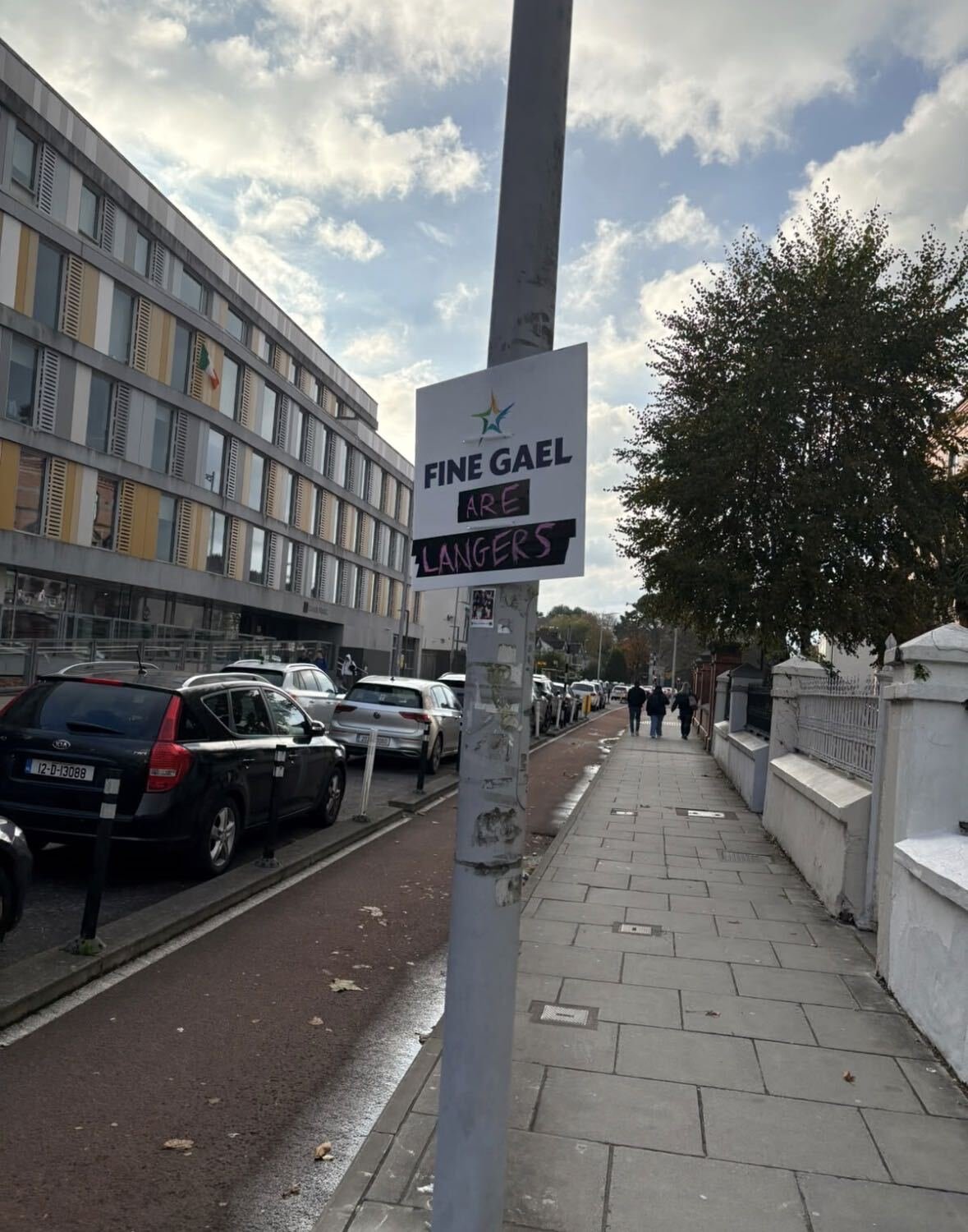
Above: An image of a sign on the Western Road the week after the Ard Fheis.
Simon Harris delivered his leader’s speech at Fine Gael’s 83rd Ard Fheis two weeks ago, held at the University College Cork (UCC)-owned Mardyke Arena. An emphasis was present throughout the speech on people and families who “work hard” and “do their bit”, just prior to mentions of the long-term unemployed and the sanctions on them that this government looks to increase and reinforce. Outwardly, the structure of the speech could be interpreted as suggesting that, despite his hopeful rhetoric, Simon Harris prioritised the aspirations and concerns of the “hardworking” middle classes, including professionals, farmers and fishers, over those of people dependent on social welfare. It could also be seen that, despite the two Ard Feiseanna with Harris at the helm being hosted in universities (University of Galway in 2024) and the repetition of the “New Energy” talk, the issues of first-time homeowners, pensioners and, of course, the aforementioned business owners, farmers and fishers were all featured at length throughout the speech before any mention of students.
This sentiment was expressed at Leaders’ Questions on Thursday, 12 November, when Social Democrats TD and University College Cork (UCC) alumnus Eoin Hayes accused Harris of “demonising the most vulnerable in our society”. Furthermore, there has been no comment on the event by the University College Cork Students’ Union (UCCSU), which only this week staged a protest (albeit a silent one) in response to one government senator coming to campus, but refrained from demonstrations over the weekend of the Ard Fheis. UCCSU protested Senator Margaret Murphy O’Mahony’s visit but did not publicly demonstrate during the Ard Fheis, despite previously expressing concerns regarding the triple lock.
Questions remain regarding the terms under which Fine Gael was permitted to use the Mardyke Arena, a venue that does not appear among the spaces publicly advertised through the Conferences and Events Office, with many of the keynote speeches, including party leader Simon Harris’ speech, taking place there. University Express contacted the office to enquire about the following: Did Fine Gael hire the Mardyke Arena for the Ard Fheis, and if so, was the venue provided on standard commercial terms? By the publication of this article, that email will be almost two weeks old, and we are yet to receive comments
We also reached out to Young Fine Gael (YFG), as well as Ógra Sinn Féin, Ógra Fianna Fáil and the Connolly Youth Movement, for comment on the Ard Fheis, the key policies announced, and the broader feeling about the direction of party politics in Ireland following the Ard Fheis, particularly as it pertains to young people and UCC students. However, we only received responses from Young Fine Gael and Ógra Fianna Fáil.
Young Fine Gael argued that, despite only sporadic mention of students in the main speeches, “YFG’s National executive and the UCC Branch secured the passage of several key motions, ensuring issues affecting young people remained firmly on the agenda at our recent Ard Fheis”, and in their lengthy submission, they also stated that the youth wing of the party was “far from an afterthought”, claiming that “20% of policy motions were submitted by YFG branches”. Finally, they stated that several policies on behalf of young people were secured by YFG at the Ard Fheis, citing the expansion of Student Universal Support Ireland (SUSI) eligibility to middle-income households (€55,000–€75,000), the national minimum wage for apprentices, and increasing stipends for publicly funded PhD students.
Although these proposals were directed at young people, they did not focus primarily on housing and cost-of-living concerns, which emerged as the dominant issues among students surveyed by University Express. This will be discussed later regarding survey results from UCC students.
Conversely, Ógra Fianna Fáil stated that “His (Simon Harris’) comments about people in receipt of State Financial supports … a dog whistle to the right of Irish Politics is a common habit for Fine Gael leaders when they are bereft of new ideas and incapable of exhibiting the leadership Irish society needs to ensure unity prevails over division.”
While the response from Ógra Fianna Fáil was clearly partisan, it raises a point that pertains uniquely to UCC students who, unless another election is called before the time comes, will likely shape the makeup of this next government more than young people previously have, as the generation of staunch party men and women in parishes around the country slowly fades into the past: What is Fine Gael for? In a recent appearance on The Irish Times’ Inside Politics podcast with Hugh Linehan, UCC Department of Government and Politics lecturer Theresa Reidy stated, “For much of the 20th century Irish had an electorate that was pretty much clustered substantially on the Centre Right … that’s all that they were offered but that’s where the voters were.” Reidy subsequently added, “Certainly the electorate has moved (left) towards the Centre”. Reidy spoke at length about the natural voter base of Fine Gael, being primarily landed rural people and urban professionals, and how that group is both shrinking in size while simultaneously growing in value from an electoral standpoint. “They’re getting older and older with every passing generation and the problem is the parties haven’t been able to replace those loyal voters.” Reidy argues that Fine Gael’s traditional voter base is shrinking, while the Ard Fheis messaging appeared heavily directed towards that same constituency.
A survey regarding the Ard Fheis and Fine Gael more generally was sent to UCC students, and these were the results: 80% of the respondents believe that national parties generally do not engage sufficiently with students and their issues. In terms of what specifically these issues are, from a list of housing, cost of living, fees, employment, mental health services and transport, either housing or the cost of living was the number one issue for 90% of students surveyed.
Ultimately, Ireland’s political economy is in an age of change, and when the students of today become the electorate of tomorrow, perhaps there will be a shift in the market towards a different kind of policy provision that prioritises issues such as the cost of living and housing, which are especially pertinent to the demographics that are most valuable to parties – young people who will be voting for decades to come. With the decline of establishment parties in Ireland and beyond, it is vital that the populace shapes the policy, not the other way around. The hosting of the Ard Fheis at UCC presented an opportunity for Fine Gael to translate its rhetoric of "New Energy" into meaningful engagement with younger voters, while providing UCCSU with an opportunity to advocate for students' concerns in relation to government positions through tangible action. Whether either organisation adequately utilised this opportunity raises a broader question as to how in touch they are with the priorities of their respective electorates.
